
ssp. ustulata (Schaller, 1783)
[= Leptura Splendida Herbst, 1784]
[= Leptura praeusta Fabricius, 1787]
[= Leptura adusta Gmelin, 1790]
Subfamilia: LEPTURINAE / Tribus: LEPTURINI
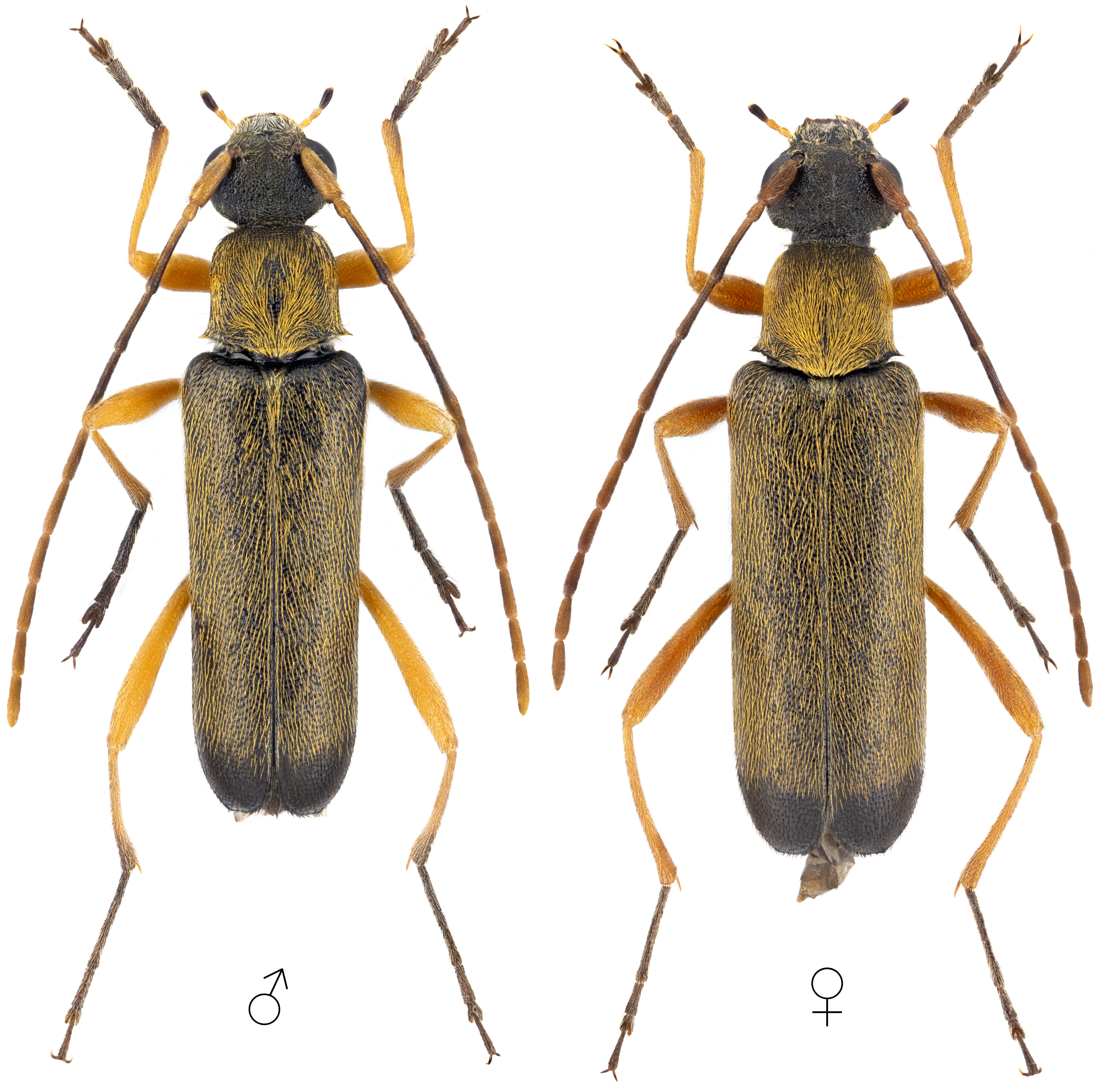
[Photo © David Navrátil, click on the picture for 4K resolution]
Grammoptera ustulata, a widely distributed Euro-Anatolian species of oak forests, has been described as Leptura ustulata from Halle environs (Germany) by Johann Gottlob Schaller in 1783 [❖]
G. ustulata, analogously to Grammoptera abdominalis, develops in rotten branches of deciduous trees attacked by a fungus Vuilleminia comedens. The larvae of this species feed centrally in the branches and later they create pupal cells perpendicular to the branch axis. The pupal cell leads directly under the bark surface and is not secured by any wad of frass as it is common in other Cerambycidae. The preferred habitat of this species are oak woods growing on south facing slopes of river valleys in Central Europe [✳][✮]. Adults, active from late April to July, are diurnal and anthophilous.
Body length: ♂♂ 5 - 7 mm / ♂♂ 6 - 9 mm Life cycle: 1 year Adults in: end of April - July Host plant: polyphagous on deciduous trees, associated with a fungus Vuilleminia comedens (prefers oaks - Quercus spp.) Distribution: Europe, Caucasus, Transcaucasia, Turkey
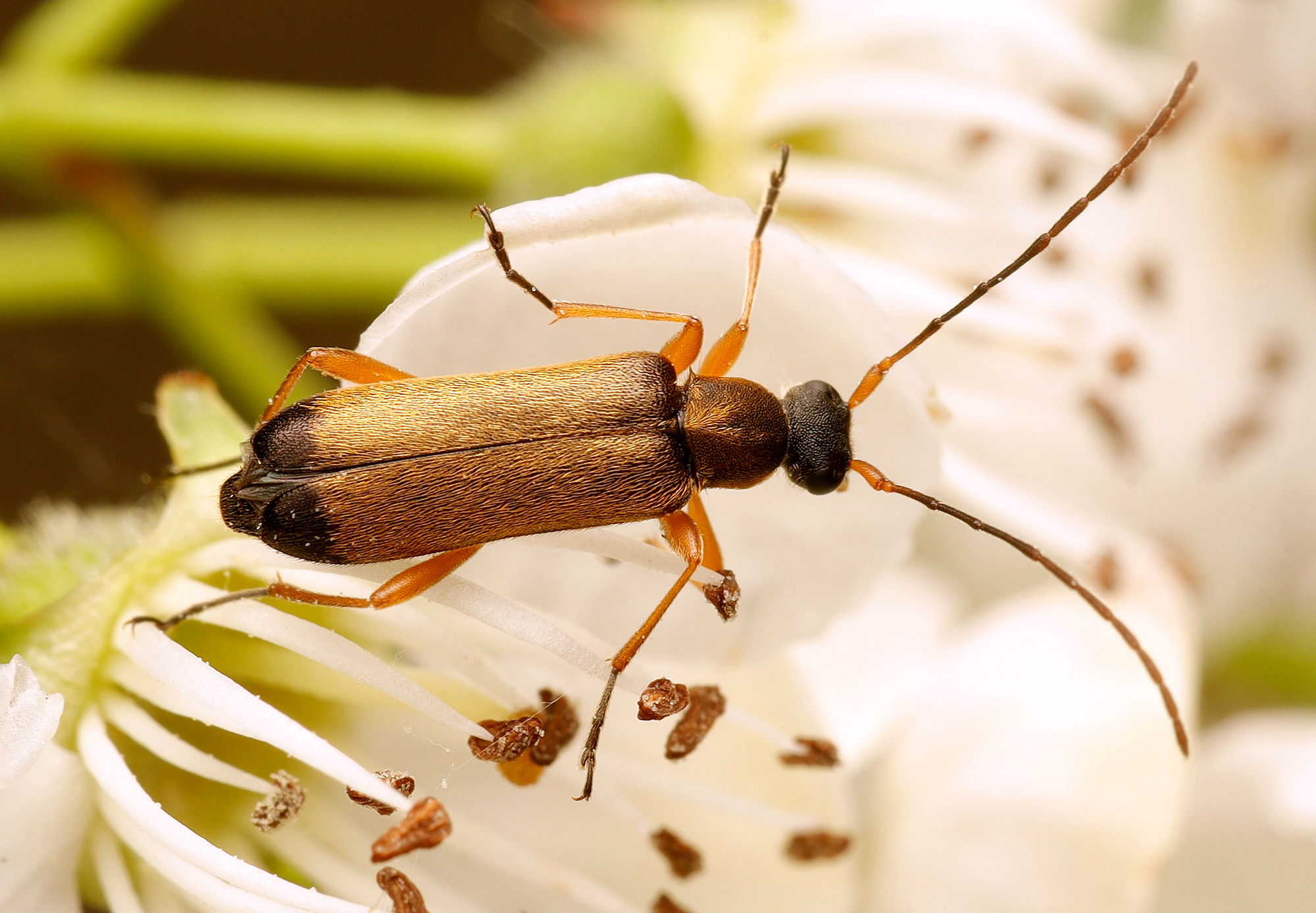
The depicted mounted beetles were: ♂ - reared from larva found in dead oak (Quercus robur) branch in Jaroslav village environs (Pardubice district, Pardubice region, East Bohemia, Czechia) in February 2005; ♀ - beaten from blossoming hawthorn in Pohansko chateau environs (Břeclav district, South Moravia, Czechia) on May 9, 2003. The living specimens were photographed in Norfolk county (England, UK) on May 5, 2024.Collected by David Navrátil and Martin Rejzek
[❖]
Schaller J.G.:
Neue Insekten beschrieben.
Schriften der naturforschenden Gesellschaft zu Halle 1: 217-328, 1783. [download]
[✳]
Sláma M.E.F.:
Tesaříkovití – Cerambycidae České republiky a Slovenské republiky / Cerambycidae of the Czech Republic and Slovak Republic.
Milan Sláma private printing, Krhanice, 383pp [pages 220-221], 1998 [ISBN: 80-238-2627-1]. [download[✮]
Vitali F.:
Atlas of the Insects of the Grand-Duchy of Luxembourg: Coleoptera, Cerambycidae.
Ferrantia, Musée national d’histoire naturelle, Luxembourg 79: 1-208 [pages 90-91], 2018. [download


[Photo © Martin Rejzek]
| Subfamilia | Lepturinae Latreille, 1802 |
| Tribus | Lepturini Latreille, 1802 |
| Genus | Grammoptera Audinet-Serville, 1835 |
| Subgenus | Grammoptera Audinet-Serville, 1835 |
| Species | Grammoptera (Grammoptera) ustulata (Schaller, 1783) |
| Subspecies | Grammoptera (Grammoptera) ustulata ustulata (Schaller, 1783) |