
Subfamilia: NECYDALINAE / Tribus: NECYDALINI
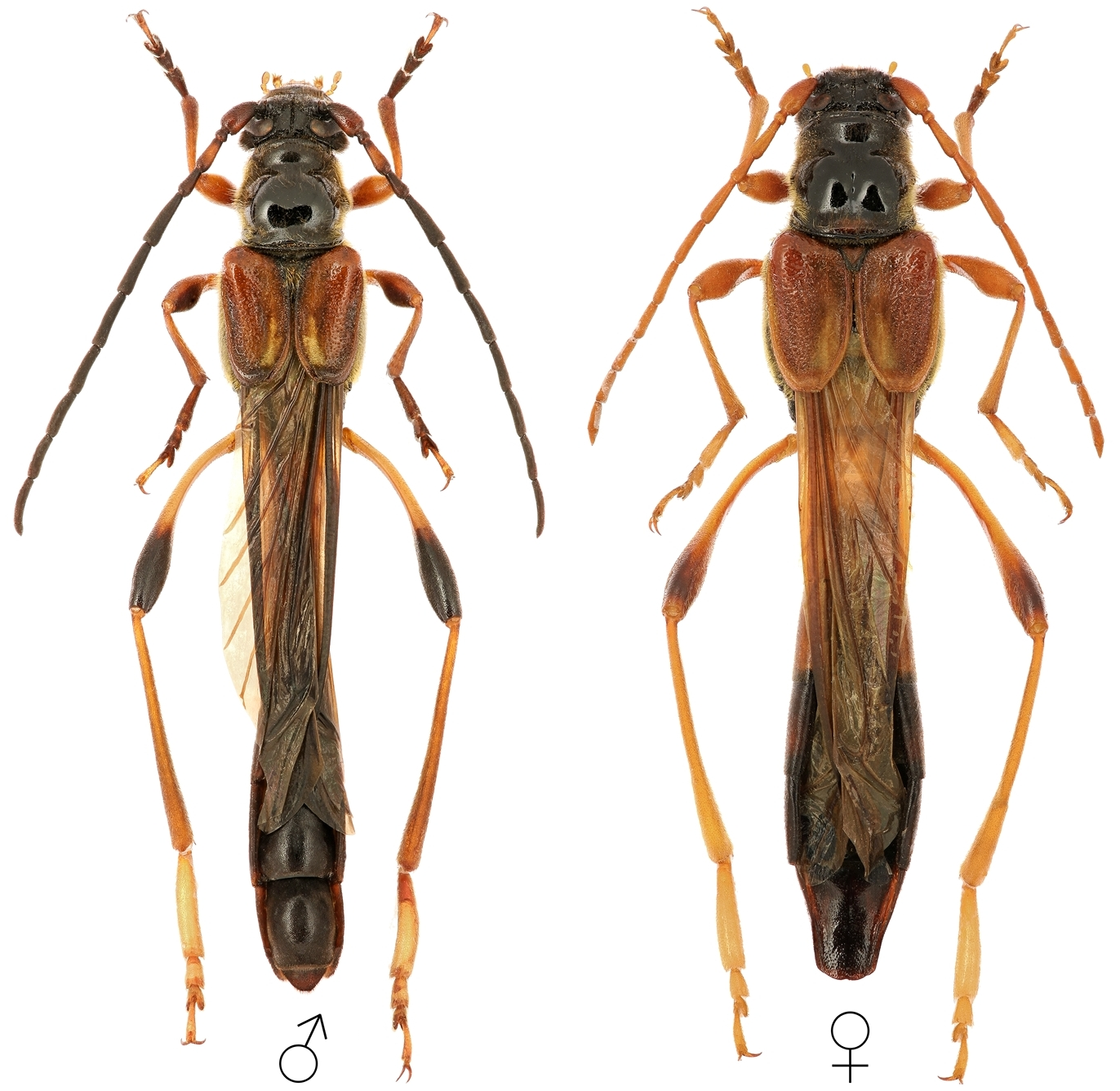
[Photo © Lech Kruszelnicki]
According to Rejzek & Vlasák [❖] Necydalis major develops in a variety of deciduous trees preferring Tilia, Quercus, Salix, Populus, but mainly Alnus. In contrast to Necydalis ulmi this species develops in dead trunks and branches of larger diameter. It never develops in hollows of living trees. Surprisingly, from a dead trunk of common alder (Alnus glutinosa) attacked by larvae of N. major the polypore Inonotus radiatus was isolated. Larvae of N. major seem to prefer a rusty-brown substrate just under the fruitbodies of I. radiatus but were also found in more decayed parts of the trunk, in a white substrate. Sometimes, analogously to N. ulmi, the larval galleries were surrounded by a rusty-brown mycelar circle well visible especially when the galleries were built in the white substrate. On the other hand, larvae of N. major were also found in highly decayed trunks of Tilia, Quercus, Ulmus, and Salix with no trace of any Inonotus species presence. Therefore, it can be concluded that the substrate requirements of N. major are much less strict than in case of N. ulmi. This observation correlates with the fact that N. major is a much more frequent species in nature than N. ulmi.
Body length: 19 - 32 mm Life cycle: 3 years Adults in: June - August Host plant: polyphagous in deciduous trees Distribution: Europe, Caucasus, Kazakhstan, Russia
The depicted living beetles were reared from a larvae found in a dead standing trunk of alder (Alnus glutinosa); collected near Třeboň (South Bohemia, Czechia).Collected by Lech Kruszelnicki
[❖]
Rejzek M. and Vlasák J.:
Larval nutrition and female oviposition preferences of Necydalis ulmi Chevrolat, 1838.
Biocosme Mésogéen (Nice) 16 (1-2): 55-66, 2000.Sláma M.E.F.:
Tesaříkovití – Cerambycidae České republiky a Slovenské republiky / Cerambycidae of the Czech Republic and Slovak Republic.
Milan Sláma private printing, Krhanice, 383pp [pages 185-186], 1998 [ISBN: 80-238-2627-1]. [download]
| Subfamilia | Necydalinae Latreille, 1825 |
| Tribus | Necydalini Latreille, 1825 |
| Genus | Necydalis Linnaeus, 1758 |
| Subgenus | Necydalis Linnaeus, 1758 |
| Species | Necydalis (Necydalis) major Linnaeus, 1758 |